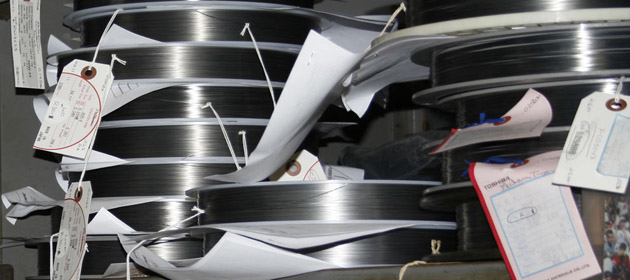
H. Cross Company is the leading specialty metal rolling manufacturer of precision ribbons, sheets, foils and strips of tungsten and tungsten-base alloys. It also supplies wire, rod and tubing. H. Cross Company sells no product from stock; all its products are made to your exact specifications.
History of Tungsten and Tungsten Alloys
The word “tungsten” is an adaptation of the Swedish tung sten (heavy stone) and was first applied to the mineral scheelite about 1758. The element was first identified in 1781 by a Swedish chemist, K.W. Scheele, for whom the calcium tungstate mineral, scheelite, was later named. Commercially, tungsten is prepared from scheelite.
Further processing results in a yellow powder of tungsten tri-oxides that would be considered extremely pure by most commercial standards. However, the desired properties of tungsten wire are affected so adversely by minute quantities of unwanted impurities that another purification is added. This consists of re-dissolving the hydroxide, purifying the solution, and crystallizing the tungsten out in the form of ammonium paratungstate.
Applications
Tungsten is practically the only material used for electron emitters. Even though other more electropositive metals would have higher emission rates, the advantage of tungsten is its extremely low vapor pressure even at high temperatures.
This property is also important for electrical contact materials. While more conductive metals like copper or silver evaporate under the conditions of electric arc, tungsten withstands these.
The following illustrates some of tungsten’s applications:
- Directly heated cathodes or heater coils for indirectly heated cathodes in cathode ray tubes for TV sets or computer displays, X-ray tubes, electron tubes, klystrons, magnetrons for microwave ovens.
- Thoria or rare earth oxide alloyed electrodes for inert gas welding, as well as High Intensity Discharge (HID) lamps.
- Tungsten disks for substrate of high power semiconductor rectifying devices; Electrical contacts.
- High temperature furnace parts such as tungsten heating coils, reflectors and structural material.
- Tungsten / tungsten-rhenium thermocouples for measuring the temperature in such furnaces.
- X-ray tubes for medical use are not only equipped with a tungsten emitter coil, but also a static anode made of tungsten or tungsten-rhenium. Important here are not only the low vapor pressure, but also tungsten’s good heat conductivity and the wavelength of the resulting X-rays.
- Modern business machines, such as photocopiers, facsimile machines, laser printers and air cleaners are equipped with tungsten charger wires. Not only drawn tungsten wire, but also electro-polished, gold-plated or platinum clad tungsten wires are used for this application.
- Modern computer processors generate a heat output per square centimeter similar to that of a household cook top. Tungsten-copper heat sinks and the processor fan remove the heat.
Fabrication and Material Forms
Tungsten has such a high melting temperature (3410° C) that it is impractical to transform it into ingot forms by conventional furnace melting techniques. Its manufacture by powder metallurgy consists of three distinct phases: the decomposition of the ore and its reduction to pure metal powder, the pressing of this powder into bars and the sintering of these bars into solid ingots and the swaging, rolling or drawing of these ingots into desired forms and sizes.
Alloys of Tungsten
In addition to commercially pure tungsten we offer several alloys that are used for specialized applications. These products are 3% Rhenium Tungsten, 5% Rhenium Tungsten and 25% Rhenium Tungsten. The addition of rhenium to the tungsten increases the ductility and shock resistance at higher temperatures encountered in thermocouple and electronic applications among others.
Surface Finishes
A colloidal graphite lubricant, which imparts a black coating to “as drawn” tungsten wire, is used to protect the wire from oxidation and to lubricate the wire as it passes through the die. Many applications require tungsten wire with characteristics other than those obtainable in “as drawn” wire. A variety of processes produce wire with a cleaned surface or with a special finish.
After drawing operations have been completed, the wire may be cleaned by exposure to elevated temperatures in a reducing atmosphere. Treating the surface chemically or electrolytically can also clean tungsten wire. (The diameter of the wire may be further reduced after drawing by electrolytic etching.)
The cleaned wire can be electroplated with such elements as gold, silver, nickel and copper, for use primarily in electronic tubes.
Packaging
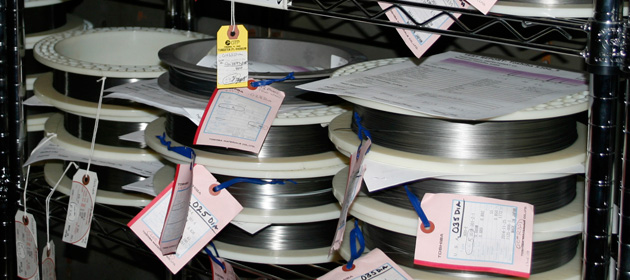
All H. Cross Company products are delivered in packaging specifically designed for the product’s application. As an example, wire is furnished on returnable plastic reels containing a single length of wire.
If required, H. Cross Company can adopt standard packaging methods or develop new ones for your special needs.